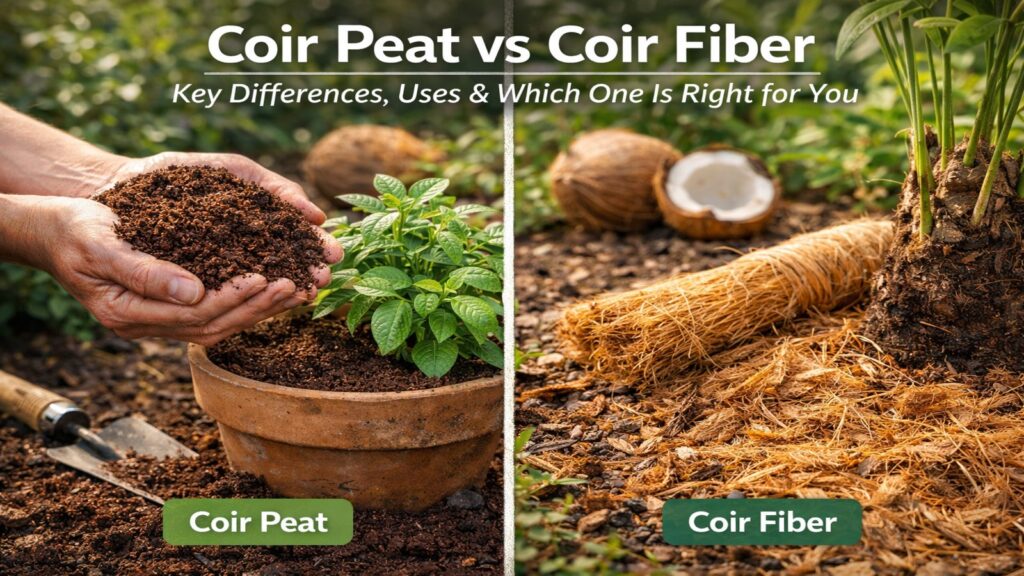
When it comes to sustainable growing media, coconut coir products have become a top choice for gardeners, farmers, and hydroponic growers. But many people still get confused about the difference between coir peat vs coir fiber.
Both are derived from coconut husks, yet they serve completely different purposes. In this guide, we’ll break down coir peat vs coir fiber, their properties, uses, and help you decide which one is best for your needs.
📑 Table of Contents
- What Is Coir Peat? (Coco Peat Explained)
- How Coir Peat Is Made
- Physical & Chemical Properties of Coir Peat
- Common Uses of Coir Peat in Agriculture & Gardening
- What Is Coir Fiber? (Coconut Fiber Explained)
- How Coir Fiber Is Extracted & Processed
- Types of Coir Fiber: White Coir vs Brown Coir
- Industrial & Agricultural Applications of Coir Fiber
- Coir Peat vs Coir Fiber: Side-by-Side Comparison
- Which Should You Choose? Use-Case Recommendations
- Can You Use Coir Peat and Coir Fiber Together?
- Ideal Mixing Ratios for Different Plants
- Environmental Impact: Sustainability of Coir Products
- Final Thoughts
What Is Coir Peat? (Coco Peat Explained)
Coir peat, also known as coco peat or coir dust, is a fine, soil-like material made from coconut husks. It’s widely used as a growing medium due to its excellent water retention and eco-friendly nature.
How Coir Peat Is Made
Coir peat is produced during the processing of coconut husks. After extracting fibers, the leftover dust and particles are:
- Washed to remove salts
- Dried naturally or mechanically
- Compressed into blocks or briquettes
This process makes coir peat lightweight, easy to transport, and convenient to use.
Physical & Chemical Properties of Coir Peat
- High water retention (holds up to 8–10 times its weight)
- Excellent aeration for roots
- Neutral to slightly acidic pH (5.5–6.8)
- Low nutrient content but high cation exchange capacity (CEC)
- Good buffering capacity
These properties make it ideal for soil conditioning and hydroponics.
Common Uses of Coir Peat in Agriculture & Gardening
- Seed germination and nursery raising
- Hydroponic farming systems
- Potting mixes and indoor plants
- Soil conditioning in dry regions
- Greenhouse cultivation
Coco peat benefits include improved root growth, better moisture control, and reduced soil compaction.
What Is Coir Fiber? (Coconut Fiber Explained)
Coir fiber is the long, coarse fiber extracted from coconut husk. Unlike coir peat, it is more rigid and used for structural and industrial purposes.
How Coir Fiber Is Extracted & Processed
The process involves:
- Retting (soaking coconut husks in water)
- Mechanical defibering
- Drying and grading
The fibers are then bundled or processed into ropes, mats, or brushes.
Types of Coir Fiber: White Coir vs Brown Coir
White Coir
- Extracted from immature coconuts
- Finer and more flexible
- Used for ropes and fishing nets
Brown Coir
- Extracted from mature coconuts
- Stronger and more durable
- Used in mats, brushes, and erosion control
Industrial & Agricultural Applications of Coir Fiber
- Coir mats and ropes
- Erosion control blankets
- Mulching material in farming
- Upholstery and mattresses
- Geo-textiles for landscaping
Coir fiber uses are more structural compared to coir peat.
Coir Peat vs Coir Fiber: Side-by-Side Comparison
Texture, Structure & Water Retention
- Coir Peat: Fine, powdery, sponge-like; excellent water retention
- Coir Fiber: Coarse, stringy; moderate water retention
Coir peat is better for moisture retention, while fiber improves soil structure.
Nutrient Content & pH Levels
- Coir Peat: Neutral pH, low nutrients but good nutrient holding capacity
- Coir Fiber: Minimal nutrient value, mainly structural
Decomposition Rate & Longevity
- Coir Peat: Decomposes slowly (2–3 years)
- Coir Fiber: Takes longer to break down, more durable
Cost & Availability
- Coir peat is widely available in compressed blocks
- Coir fiber may be slightly costlier depending on processing
In regions like India, both are affordable due to abundant coconut production.
Which Should You Choose? Use-Case Recommendations
Choosing between coir peat vs coir fiber depends on your application.
Best Choice for Seed Starting & Germination
Coir Peat
- Soft texture supports root growth
- Retains moisture for consistent germination
- Free from weeds and pathogens
Best Choice for Soil Amendment & Mulching
Coir Fiber
- Improves soil aeration
- Prevents soil erosion
- Ideal for mulching in open fields
Best Choice for Hydroponics & Soilless Growing
Coir Peat
- Excellent for hydroponic systems
- Maintains moisture balance
- Widely used as a coir growing media
Best Choice for Erosion Control & Landscaping
Coir Fiber
- Strong and durable
- Used in geo-textiles and slope stabilization
- Ideal for landscaping projects
Can You Use Coir Peat and Coir Fiber Together?
Yes, combining both creates a highly effective growing medium.
Creating Custom Coir-Based Growing Media
Mixing coir peat and fiber gives:
- Balanced moisture retention
- Improved aeration
- Better root development
This combination is widely used in commercial horticulture.
Ideal Mixing Ratios for Different Plants
- Vegetables & leafy greens: 70% coir peat + 30% fiber
- Flowering plants: 60% peat + 40% fiber
- Succulents: 50% peat + 50% fiber (better drainage)
Environmental Impact: Sustainability of Coir Products
One of the biggest advantages of coconut coir is sustainability.
- 100% natural and biodegradable
- Made from coconut waste (eco-friendly)
- Reduces dependence on peat moss
- Renewable and widely available
Using coconut coir for gardening supports eco-conscious farming and reduces environmental damage.
Final Thoughts
Understanding the difference between coir peat and coir fiber is key to choosing the right material for your needs.
- Use coir peat for water retention, hydroponics, and plant growth
- Use coir fiber for strength, mulching, and erosion control
- Combine both for the best results
Whether you’re a home gardener or a commercial grower, coconut coir products offer a sustainable, cost-effective, and high-performance solution.
FAQs
- What is the main difference between coir peat and coir fiber?
Coir peat is fine and retains water, while coir fiber is coarse and used for structure and durability. - Is coir peat better than soil?
Coir peat improves soil quality but is best used as a supplement or growing medium, not a complete replacement. - Can coir fiber be used for plants?
Yes, it is mainly used for mulching, aeration, and soil structure improvement. - Is coir peat good for hydroponics?
Yes, coir peat is one of the most popular hydroponic growing media due to its water retention and aeration. - Can I mix coir peat and coir fiber?
Yes, mixing both creates a balanced growing medium suitable for many plants.