
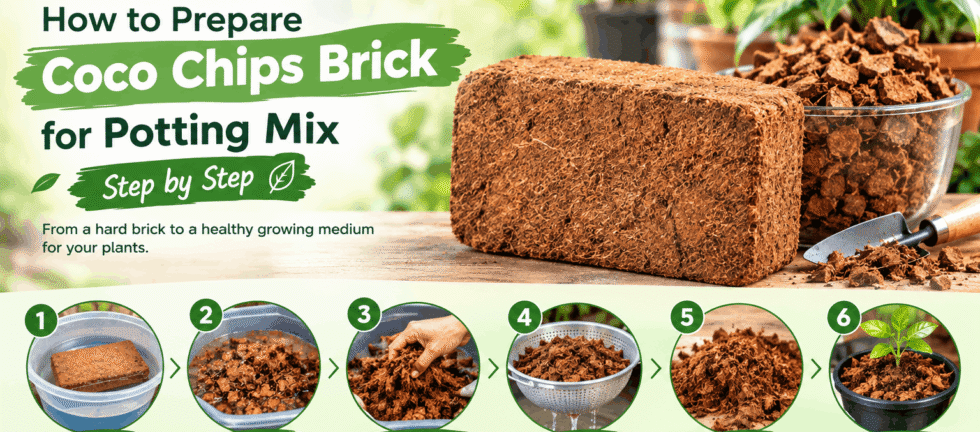
If you have ever bought a brick of coco chips and wondered how something so hard and dense turns into a light airy growing medium the answer is simpler than it looks. A little water and a bit of patience is all it takes to transform a brick into a full batch of ready-to-use potting material. This guide walks through how to prepare it, why growers rely on it and how to mix it into a potting blend that actually works for your plants.
What Are Coco Chips and Why Use Them in Potting Mix
This growing medium is made from natural coconut husks chipped into pieces to create an excellent base for potted plants. Unlike soil or bark it improves aeration around the root zone, retains moisture efficiently and supports root development without compacting over time.
It is widely used by orchid growers, anthurium cultivators and horticulture professionals either on its own or mixed with coco peat to balance moisture retention and airflow. Its durable structure means it holds up longer than bark, which tends to break down and lose its structure within a season or two.
This makes it an eco-friendly and cost-effective alternative to traditional bark or soil-based mixes whether you are running a commercial nursery or simply tending a few pots at home. Beyond structure the benefits go deeper.
A quality coco medium offers drainage thanks to a high Cation Exchange Capacity, which helps roots access nutrients more efficiently and can reduce fertilizer usage by as much as 30 percent in some growing setups. It also tends to minimize transplant shock giving roots an environment to establish in after repotting.
Step-by-Step: How to Prepare a Coco Chips Brick for Potting Mix
Step 1: Choose a container for soaking. Pick a bucket or tub large to hold the expanded volume since a compressed brick can expand to several times its original size once fully hydrated.
Step 2: Add water to the brick. Place the brick in the container. Add warm water enough to fully submerge it. Warm water speeds up the expansion process compared to water.
Step 3: Let it soak and expand. Allow the brick to absorb water for 15 to 30 minutes checking periodically. You will notice the block gradually loosening and breaking apart as it soaks.
Step 4: Break it apart by hand. Once the brick has softened, use your hands or a garden fork to break it into uniform pieces. Avoid over-mashing since you want to preserve the texture that gives this material its aeration benefit.
Step 5: Drain water. Tip out any standing water. Let the expanded material sit for a few minutes so it reaches a moist, not soggy, consistency before use.
Step 6: Fluff and inspect. Give the material a fluff to separate any remaining clumps and check that the texture is loose and even throughout, ready to be mixed or used directly in pots.
Tips for Mixing This Growing Medium with Other Potting Materials
This material can be used alone for plants like orchids that need maximum airflow around their roots but for most potted plants blending it with other materials creates a more balanced mix. Combining it with coco peat is an approach since the peat retains moisture while the chips keep the mix loose enough to prevent compaction and root rot.
For potting soil blends, mixing in regular soil or compost adds structure and improves drainage without overwhelming the mix with organic bulk. Growers working with succulents or plants sensitive to overwatering often add a ratio of these chips specifically for the drainage boost while orchid and anthurium growers may use a much higher proportion sometimes using this material alone to replicate the airy conditions these plants need in the wild.
About AV Coirs: A Trusted Manufacturer in Coimbatore
AV Coirs manufactures coco chips from natural coconut husks at its facility in Pollachi, Coimbatore, Tamil Nadu supplying growers who need a uniform growing medium. Their product is clean, uniform and free from wastage giving buyers a result rather than a mix of odd-sized fragments that behave unpredictably once soaked.
The company’s product range extends beyond this one item, including coir fibre, coir peat, coco pith coins, coir mulch mat and grow bags, which means growers sourcing multiple coir-based products can work with a single supplier instead of managing several vendors.
For nurseries and home gardeners alike AV Coirs positions its product as a genuinely long-lasting alternative to bark built to hold its structure through repeated watering cycles rather than breaking down within a season.
Frequently Asked Questions
How long should I soak a brick before using it? Most bricks fully expand within 15 to 30 minutes of soaking in water though larger bricks may take longer to soften completely.
Can the expanded material be reused after the watering cycle? Yes this growing medium is known for its durability and resistance to degradation which means it typically holds its structure across growing seasons rather than breaking down like bark.
Does it need to be mixed with anything before use? Not always. It can be used alone for plants that need airflow like orchids or mixed with coco peat, soil or compost for a more balanced potting blend depending on what you are growing.
Final Thoughts
Preparing a coco chips brick for potting mix is a process once you know the steps, soak break apart drain and fluff and the result is a durable well-draining growing medium that supports healthier root development than many traditional alternatives.
Whether you are potting orchids mixing a custom soil blend or setting up a nursery-scale operation, understanding how to prepare it properly makes the difference between a mix that performs well and one that compacts or dries out quickly.