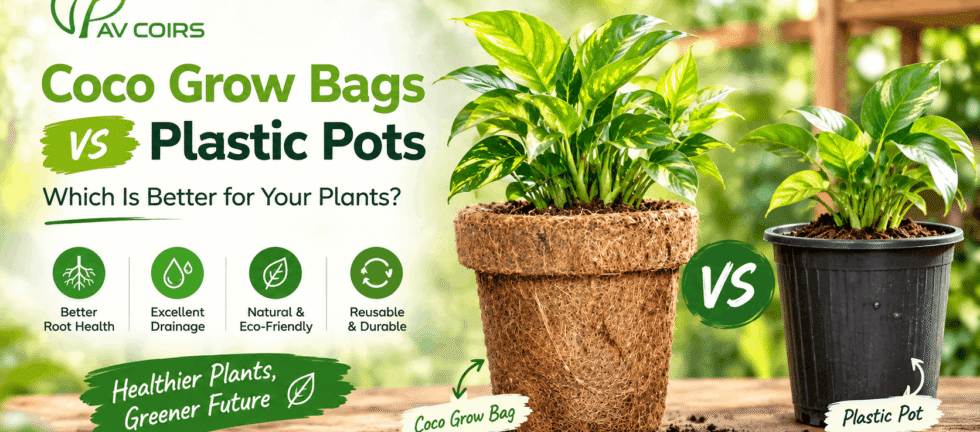
If you have ever struggled with soggy soil, weak roots, or plants that just refuse to thrive in a plastic pot, you are not alone. More home gardeners, nurseries, and polyhouse growers are switching to coco grow bags because they solve problems that plastic containers simply cannot. But is the switch really worth it? Let’s break down how coco grow bags compare to traditional plastic pots so you can decide what is right for your plants.
Quick Answer: Coco grow bags are generally better than plastic pots because they allow air to reach the root zone, drain excess water quickly, and reduce root circling and rot. Plastic pots often trap water and restrict airflow, leading to weaker root systems. For most vegetables, herbs, and nursery plants, coco grow bags support healthier, more vigorous growth.
What Makes Coco Grow Bags Different?
Coco grow bags are planter bags made of obtained material coco coir. These grow bags can be made with 100% coco coir fabric or a coco coir filled non-breathable fabric or plastic bag or with hybrid print which is a combination of coconut coir with other breathable materials.
The main idea of coco grow bags is straightforward. It provides roots with the necessary elements needed for proper growth: fresh air, proper moisture and space to grow without getting too large.
Coco Grow Bags vs Plastic Pots: The Real Differences
Conventional plastic pots and inexpensive black poly bags often hamper water drainage, hinder airflow, and lead to the circling of roots in the pot. This means that weak roots can develop and cause poor plant growth over time. Coco grow bags are the solution to these problems.
1. Drainage and Waterlogging
Plastic pots also have few drainage holes, and too much water tends to build up at the bottom of the pot. During the rainy season or in the case of overwatering, this creates a situation ideal for root rot and mold to develop.
Unlike plastic pots, coco grow bags have many drainage holes and are designed in such a way that they do not allow water to pool near the roots of the plants. This means that watering plants becomes hassle-free and growers who water the plants too much will have nothing to worry about.
2. Root Health and Aeration
This is where coco grow bags truly stand apart. The coir and fabric structure allows air to reach the root zone, promoting a process called air pruning. Instead of roots hitting a plastic wall and circling endlessly (a common issue in pots), roots in coco grow bags branch out naturally.
The result is a dense, fibrous root system with improved nutrient uptake and stronger, more resilient plants. Plastic pots simply cannot replicate this because they are sealed and non breathable by design.
3. Weight and Portability
If you are gardening on a terrace, balcony, or in a nursery where plants need to be repositioned often, weight matters. Compared to heavy clay pots or large plastic containers, coco grow bags are lightweight and easy to move around.
This makes it simple to reposition plants based on sunlight or seasonal needs, without straining your back or stressing your rooftop structure.
4. Reusability and Cost Over Time
A common myth is that fabric based grow bags are single use. In reality, quality coco grow bags can be reused for multiple growing seasons when maintained properly. This means a lower cost per crop cycle for nurseries and growers, and less waste compared to constantly buying new plastic containers.
Plastic pots do last a long time, but they also crack, fade, and become brittle under sun exposure, eventually ending up in landfills.
5. Environmental Impact
Made from natural coconut coir and or breathable fabrics, coco grow bags are biodegradable or partially biodegradable depending on the design. They offer a genuine alternative to single use plastic pots and poly bags, aligning with sustainable gardening and farming practices.
Plastic pots, by contrast, are a major contributor to the plastic waste problem in gardening and commercial nurseries alike.
Who Benefits Most From Coco Grow Bags?
The switch from plastic pots to coco grow bags is not just for hobby gardeners. A wide range of users are adopting them, including:
- Home gardeners growing vegetables, herbs, and flowers on terraces and balconies
- Commercial nurseries raising saplings, ornamental plants, and fruit plants at scale
- Greenhouse and polyhouse growers who need consistent, breathable substrate bags
- Hydroponic growers using coco peat based systems as a growing medium
- Landscapers setting up temporary or portable planting solutions
- Exporters and wholesalers sourcing bulk coco grow bags from a reliable manufacturer
About AV Coirs: Your Trusted Coco Grow Bags Manufacturer
AV Coirs is a vertically integrated grow bags manufacturer, meaning we control the process from raw material sourcing to finished product, rather than reselling generic bags. This gives us consistent quality across every batch of coco grow bags we produce.
Our process starts with sourcing coconut coir and coir pith from trusted processors, selected for low salt content, uniform particle size, and a good water retention to aeration balance. The coir is then aged and washed to reduce excess salts and dust, screened to the right grade, and checked for moisture content and cleanliness before it ever reaches the bag fabrication stage.
During fabrication, fabric bags are stitched to precise dimensions, filled with treated coco peat to the correct density, and reinforced with drainage holes where needed. Every batch then goes through quality checks covering drainage performance, stitching strength, size and weight consistency, and overall finish, before being packed for domestic delivery or export shipping.
This end to end control, from raw coir to finished coco grow bags, is what sets AV Coirs apart as a genuine manufacturer rather than a middleman. Whether you need small nursery packs or bulk export orders, AV Coirs offers custom sizing, thickness, UV stabilization, and packaging options to match your exact requirements.
Why Manufacturing Quality Matters
Not all coco grow bags are created equal, and this is where working with an experienced grow bags manufacturer makes a real difference. At AV Coirs, quality begins with sourcing coconut coir and coir pith from trusted processors, selected specifically for low salt content, uniform particle size, and a good water retention to aeration balance.
From there, the coir goes through treatment and conditioning: it is aged and washed to reduce excess salts and dust, screened to the right grade, and checked for moisture content and cleanliness. During bag fabrication, fabric bags are stitched to precise dimensions, filled with treated coco peat to the correct density, and fitted with drainage holes and reinforcement where needed.
Every batch of coco grow bags then undergoes quality checks covering drainage performance, stitching strength, size and weight consistency, and overall finish. This kind of end to end control is what separates a genuine manufacturer from a reseller simply repackaging generic bags, and it is exactly why growers can trust the consistency of every batch.
Where Coco Grow Bags Outperform Pots in Practice
Terrace and balcony gardening: Coco grow bags offer space efficient planting, easy rearrangement based on sunlight, and less mess compared to loose soil beds. They work particularly well for tomatoes, chilies, leafy greens, and flowering plants, crops that struggle in poorly drained plastic pots.
Nurseries and sapling production: Uniform bag sizing makes stacking and handling easier, while healthy root development improves transplant survival and reduces mortality from waterlogging and root diseases.
Polyhouse and hydroponic setups: In controlled environments, consistent substrate is critical. Coco grow bags support uniform water and nutrient distribution, good aeration even in humid conditions, and compatibility with drip irrigation and fertigation systems. Coco peat is also a well established hydroponic growing medium, used in both slab type and container based hydroponic systems.
Common Mistakes to Avoid
Even with coco grow bags, results depend on how you use them:
- Overwatering: Continuous dampness will harm roots even in bags with good drainage
- Choosing poor quality bags: Weak bags tear and lose shape quickly
- Neglecting drainage: Water must be able to flow out properly at all times
- Using damaged bags: A torn bag should be replaced so roots are not exposed or stressed
Frequently Asked Questions
Are coco grow bags better than plastic pots for vegetables?
Yes. For most vegetables, herbs, and nursery plants, coco grow bags provide superior root aeration and drainage, leading to healthier root systems compared to plastic pots.
Can coco grow bags be reused like plastic pots?
Good quality coco grow bags can be reused for 2 to 4 growing seasons if cleaned, dried, and stored properly, making them comparable in longevity to many plastic pots.
Do coco grow bags work for hydroponic systems?
Yes. Coco peat is a widely used hydroponic growing medium, and coco grow bags can be used in slab or container based hydroponic setups for vegetables, herbs, and berries.
Are coco grow bags suitable for commercial nurseries?
Absolutely. Nurseries benefit from uniform bag sizing, healthy root development, and reduced mortality from waterlogging, making coco grow bags a practical choice at scale.
Final Verdict
When it comes down to drainage, root health, reusability, and environmental impact, coco grow bags consistently outperform traditional plastic pots. Plastic containers may seem convenient, but they trap water, restrict airflow, and often lead to weaker plants over time. Coco grow bags solve these problems with breathable, well drained construction that supports stronger roots and better yields.
Whether you are a home gardener, a commercial nursery, or an exporter looking for bulk supply, AV Coirs offers reliable, quality tested coco grow bags built for real growing conditions. For custom sizes, bulk orders, or export ready coco grow bags, get in touch with AV Coirs today.