Two coco grow bags can appear the same. Still act very differently once the drip line starts running. The difference is often inside: how much fine peat holds the water and how many chips keep air moving to the roots. Get that balance wrong for your climate or crop and plants either sit wet or dry out fast.
That’s why talking to a coco grow bags manufacturer about the blend matters as much as choosing the bag size. This guide explains the three blend ratios AV Coirs offers, how to match them to your region and crop and what to ask before you order.
What Is Inside a Coco Grow Bag?
A coco grow bag is a soilless growing bag made of coco peat and coco chips. Peat, the fibre from coconut husk holds water. Chips keep air moving through the root zone. Together they give roots moisture without waterlogging.
Growers plant into the bag and feed through drip irrigation so there’s no soil to prepare or treat. AV Coirs says each of its bags holds triple-washed, low EC coco peat and coco chips inside a UV-treated plastic outer layer, built for polyhouse growers working from small plots to many acres. For background on the coir industry in India, see the Ministry of MSME, which oversees the Coir Board.
Why the Blend Matters When You Choose a Grow Bags Manufacturer
Because the ratio of peat to chips decides how water and air the bag keeps and only a maker who lets you pick a Blend can set Blend right for you.
More chips give drainage and more air. More peat holds more water. AV Coirs makes bags in three blends, and says it helps you choose by crop, climate and irrigation. A trader selling one fixed bag can’t do that. A grow bags manufacturer that blends its material can make grow bags.
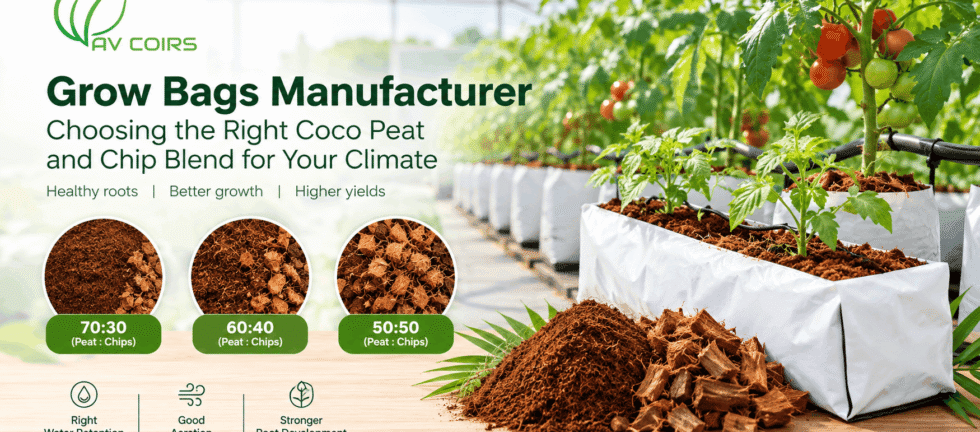
The three blends are 70:30, 60:40 and 50:50
| Blend (peat : chips) | What it favors | Where it fits |
| 70:30 | More water holding | Drier regions, per AV Coirs |
| 60:40 | A balance of the two | Between the other two options (general) |
| 50:50 | More drainage and air | Wetter regions, per AV Coirs |
The ratio is the first thing to settle. Your supplier can then adjust the size, hole spacing and packing around it.
Match the Blend to Your Climate
AV Coirs explains the logic simply. When water is scarce coco peat holds moisture so plants need frequent watering. When rainfall is heavy, chips and drainage holes let excess water leave the bag, which lowers the risk of waterlogging and root rot.
Thus the company suggests a chip share, such as 50:50 for wetter areas and a higher peat share, such as 70:30, for drier ones. Tell your supplier where you’re growing, because the right blend for a dry polyhouse isn’t the right blend for a high-rainfall site.
Match the Blend to Your Crop and Irrigation
General guidance, not a statement about any product. Crop and irrigation also shape the choice. I have noticed that plants that prefer moisture and drip schedules with long gaps tend to use more peat. I also see that crops sensitive to roots or sites that get frequent irrigation tend to use more chips.
AV Coirs lists crops that grow in AV Coirs bags, such as cucumber, eggplant, tomato, bell pepper, strawberry, blueberry, ginger, flowers and indoor plants. AV Coirs size tables suggest that strawberry, blueberry and leafy crops fit best in the slab fruiting vegetables in the mid-size slab and long-cycle crops in the larger slab. Share your crop, climate and irrigation method and AV Coirs will suggest the bag.
Specifications Worth Comparing
AV Coirs publishes specifications up front so buyers can compare before enquiring:
| Specification | Details from AV Coirs |
| Base material | Coco peat, husk chips, or a mix |
| Treatment | Triple-washed, low EC; buffered coco peat available |
| EC | Low, typically below 0.5 to 1.0 mS/cm |
| pH | 5.5 to 6.5 |
| Moisture (dry bags) | 15 to 20% |
| Standard slab | About 2.2 kg dry; 100 x 15 x 12 cm wet |
| Outer layer | UV-treated plastic |
| Holes | Pre-cut planting and drainage holes, custom spacing |
Low EC means less salt stress on young roots, and buffered coco peat is available on request for sensitive crops. Batches are tested for EC, pH and moisture before packing.
Slab Style or Pot Style?
AV Coirs makes two formats. Slab style bags are long compressed coir slabs sealed in UV-treated plastic, with pre-cut planting and drainage holes. They suit row cropping in polyhouses and greenhouses on drip systems, and the length, width, height and hole spacing can be made to your layout. Pot style bags are individual cube bags for nurseries, horticulture departments, vertical gardens, indoor plants and home growers, in standard sizes or made to order.
Questions to Ask Before You Order
If you’re comparing a grow bags manufacturer, ask each supplier:
- Which blends do you offer, and how do you recommend one for my region?
- Is the coco peat washed, and how low is the EC?
- Is buffered coco peat available for sensitive crops?
- Can you make the size and hole spacing for my layout?
- How are batches tested before dispatch?
- What packing and documents do you provide for export orders?
You can see AV Coirs’ full range on its grow bags manufacturer page.
About AV Coirs
AV Coirs is a grow bags manufacturer based in Pollachi, Tamil Nadu, making coco grow bags from its own coir processing. It supplies polyhouse growers, nurseries, horticulture departments, vertical gardens and indoor plant growers, and sells direct with no middlemen.
The process runs from coconut husk processed into coco peat and chips, through triple washing, blending, and compressing and sealing in UV-treated plastic, to a quality check and palletised packing. AV Coirs also exports coco grow bags to the USA, Canada, Australia, China, Korea and Europe, and offers private-label printing for distributors.
For growers who want a grow bags manufacturer that explains the blend, the team is easy to reach. 40 Chairman Street, Rajamil Road, Pollachi is the address. Call +91-97881 70777 or email info@avcoirs.com. The homepage of AV Coirs is another option.
Frequently Asked Questions
What is the difference between 70:30, 60:40 and 50:50 blends?
The numbers show how much coco peat and how much coco chips are in the mix. More coco chips mean drainage and more air around the roots. More coco peat means the mix holds water. AV Coirs recommends a 70:30 blend, for areas because it keeps moisture longer. For areas a 50:50 blend works better to avoid waterlogging.
What does low EC mean?
EC measures salt in the medium. AV Coirs says its coco peat is triple-washed to a low EC, which reduces salt stress on young roots, and buffered coco peat is available for sensitive crops.
What kinds of crops are suitable for growing in coco grow bags?
AV Coirs lists cucumber, eggplant, tomato, bell pepper, strawberry, blueberry, ginger, flowers and indoor plants. Share your crop and climate. The team will recommend a coco grow bag.
Can I get custom sizes and hole spacing?
Indeed. Slab bags can be customized in length and hole spacing according to your greenhouse layout or row spacing, and all sizes are created to order. Tell the team your requirements.
Where can I locate a manufacturer of grow bags for export orders?
AV Coirs exports coco grow bags to the USA, Canada, Australia, China, Korea and Europe. Bags are palletised for container loading, and private-label printing is available. Ask about samples, documents and shipping.
Get the Blend Right Before You Order
The proper ratio of water to air is the first step in making the ideal bag. Tell your supplier your crop, climate, irrigation and layout, and ask for the blend, size and hole spacing to match.
Go to the AV Coirs grow bags manufacturer website and get a quote if you’re prepared to discuss your polyhouse with a grow bag manufacturer.