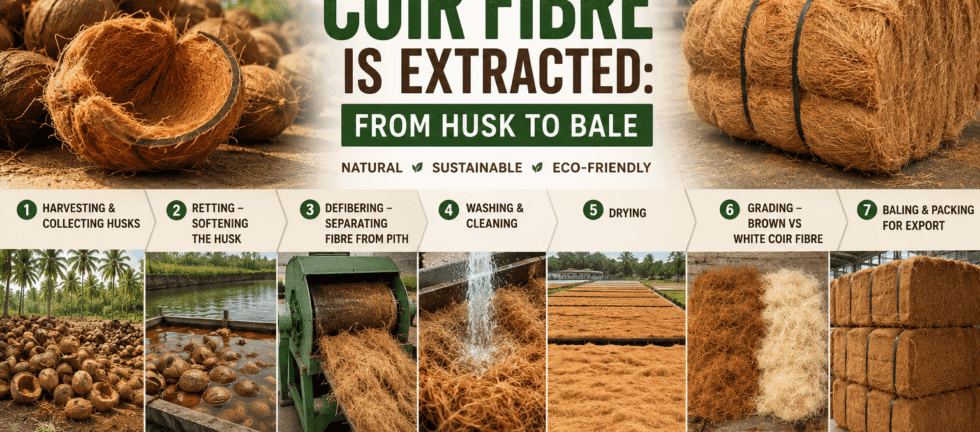
Coconut husk goes through extraction of Coir fibre through various stages such as harvest of the coconut husk, retting which is a process of softening the husk, defibering which is the separation of fibre from the pith, washing, drying and sorting the coir through colour and size. The entire process from the ineligible coconut husk to the saleable bailed coir takes between a few days to a few weeks depending on the way in which the retting of husk is done.
Table of Contents
- What Is Coir Fibre Extraction?
- Step 1: Harvesting and Collecting Coconut Husks
- Step 2: Retting — Softening the Husk Naturally
- Step 3: Defibering — Separating Fibre from Pith
- Step 4: Washing and Cleaning
- Step 5: Drying
- Step 6: Grading — Brown vs White Coir Fibre
- Step 7: Baling and Packing for Export
- How AV Coirs Handles This Process, Start to Finish
- Why the Extraction Process Matters If You’re Buying Coir Fibre
- FAQs
What Is Coir Fibre Extraction?
If you have ever wondered about the processes involved in making coir doormats or coco peat growing blocks and how the coconut husk is processed into a material that is so usable before your eyes, you may be surprised to find out that this is a process that takes place behind the scenes and has been perfected through centuries of coir works in places such as Pollachi and Kerala.
Coir fibre extraction is a process during which the coarse fibre parts located inside the coconut husk are removed from the soft spongy material surrounding them – the pith. The result of the process is two different materials: coir fibre and coir pith. If something is wrong with the process, then the length of fibre will vary, meaning that the end product will not be perfect either.
Step 1: Harvesting and Collecting Coconut Husks
It starts with the husk itself — the fibrous outer covering between a coconut’s hard shell and its outer skin. Husks are collected after the coconut meat and water have already been used elsewhere, which is part of what makes coir fibre such a genuinely sustainable material: it’s built from what used to be treated as agricultural waste.
The quality of coir fibre produced from different husks varies among husks, as mature coconuts provide the rough husk used to make brown coir fibre while the young coconuts produce the soft husk which will eventually be converted into the white coir fibre. This is the first decision point in the entire process and will ultimately determine the purpose of the extracted fibre nearly at the beginning of the process.
Step 2: Retting — Softening the Husk Naturally
Retting is where coir fibre extraction really begins, and it’s arguably the most important stage in the whole process. Retting is a controlled decomposition process that softens the husk and loosens the fibre from the pith, using water and naturally occurring microbes to break down the pectin that binds everything together.
There are two broad approaches:
Water retting is the traditional method — husks are submerged in backwater, ponds, or tanks for anywhere from a few months to nearly a year, depending on the region and the water conditions. This is a slow, natural process, but it produces some of the finest, most flexible white coir fibre, which is why it’s still used for high-grade rope and yarn production.
By employing either modern or mechanical retting, the entire process is trimmed down from weeks to sometimes even a few days. Instead of soaking in an open water body, mechanical relics utilize mechanical softening and Кеtting tanks to process the husk in a more efficient way. Since this method speeds up the process considerably and does not require the husk to be stored in open ponds for a long time, it is a more widely used technique of coir fiber production.
Regardless of the method of choice, the end goal remains the same — one needs to make the husk soft enough so that fibers could be separated from the pith without damaging the fibers.
Step 3: Defibering — Separating Fibre from Pith
Once the husk has been properly retted, it goes through defibering — the mechanical stage where rotating drums, beater machines, or crushing rollers physically pull the fibre away from the pith. This is where coir fibre and coir pith (also known as coco peat) officially become two separate raw material streams.
This stage requires real judgement, not just machine settings. Push a husk through too aggressively, and you shorten and weaken the fibre. Under-process it, and pith residue stays trapped in the fibre bundles, which shows up later as inconsistent quality in the finished bale.
Appropriately processed fiber shall ensure clean and completely separated fibers with minimum contamination of pith. The length of the fiber strands is kept within usable limits, according to the planned application, be it rope, brush, mattress filling, or geotextile product.
Step 4: Washing and Cleaning
After defibering, the raw coir fibre still carries residual pith dust, dirt, and organic debris from the retting process. Washing removes this, typically using clean water passes that rinse the fibre without breaking down the strand structure. This step matters more than it sounds — fibre that isn’t properly washed retains a higher moisture content and can develop mould or odour issues later in storage or during shipping, which is a real problem for export-grade coir fibre travelling long distances by sea.
Step 5: Drying
Wet fibre straight out of the washing stage can’t be baled or stored — it needs to be dried down to a stable moisture level, usually through sun-drying on open drying yards, though larger operations increasingly use mechanical drying to reduce weather dependency and speed up turnaround. Proper drying is what gives coir fibre its long shelf life and resistance to microbial degradation during storage and transit — a big part of why coir fibre remains usable and stable for years without special preservation treatment.
Step 6: Grading — Brown vs White Coir Fibre
This is where experience really separates a reliable coir fibre supplier from an inconsistent one. Grading isn’t something that can be fully automated — fibre length, colour uniformity, and tensile strength are typically checked by hand, batch by batch, to catch inconsistent lots before they ever reach a bale.
- Brown coir fibre, from mature husks, is coarser and stronger — the natural choice for brushes, doormats, brooms, and upholstery padding, where durability under mechanical stress matters more than flexibility.
- White coir fibre, from tender husks, is softer and more pliable — better suited to rope, twine, and net-making, where flexibility is the priority.
Skipping proper grading is one of the most common causes of buyer complaints in the coir industry — a rope manufacturer receiving a brown-heavy batch meant for twine production, for instance, ends up with a product that simply doesn’t perform.
Step 7: Baling and Packing for Export
The final stage compresses graded, dried coir fibre into dense bales using hydraulic presses, typically wrapped and strapped with rust-free iron hoops or plastic straps to keep the bale compact and stable through handling, storage, and shipping. Proper baling isn’t just about compression for its own sake; it directly affects shipping efficiency, since a well-compressed bale means more usable fibre per container and fewer losses from loose strand breakage in transit.
How AV Coirs Handles This Process, Start to Finish
We don’t outsource any part of this process, and that’s a deliberate choice, not a marketing line. Every husk that reaches our facility in Pollachi — a region that’s been a coir-processing hub for generations, sitting close to some of Tamil Nadu’s densest coconut cultivation — goes through retting, defibering, washing, drying, and grading under our own roof.
Because we process both coir fibre and coco peat from the same husk stream, our grading discipline benefits both product lines: neither is a rushed by-product of chasing yield on the other. Fibre length, colour, and tensile strength are checked by hand before baling, which is how we catch inconsistent batches before they ever ship — not after a customer flags a problem three weeks into production.
Why the Extraction Process Matters If You’re Buying Coir Fibre
When you are looking for coir fibre, whether for the purposes of making rope, brushes, mattress stuffing, or using it in geotextile materials, it is essential to have an understanding of how a company’s fiber extraction process impacts the fiber itself.
A supplier who hastily processes the fiber through the retting, does not invest enough in washing, or does not bother with grading will present the fiber with similar specifications on paper while the performance will be different in the production.
Knowing how the extraction process works — and not just what grade it is — is a simple way to tell the difference between the actual manufacturer and the reseller.
FAQs
How long does it take to extract coir fibre from husk?
It depends on the resting method. Traditional water retting can take several months to nearly a year, while mechanical retting shortens this to just a few days, followed by defibering, washing, drying, and grading, which together typically add another few days to the timeline.
What’s the difference between coir fibre and coir pith?
Coir fibre is the coarse, strand-like material extracted from the husk, used in ropes, brushes, and mattresses. Coir pith (also called coco peat) is the fine, spongy material that binds the fibre together inside the husk, primarily used as a growing medium in horticulture.
Is coir fibre extraction an eco-friendly process?
Yes. Coir fibre extraction uses coconut husk that would otherwise be discarded as agricultural waste, and the process itself — particularly water retting — relies on natural decomposition rather than chemical treatment, making the finished fibre fully biodegradable.
Why does grading matter in coir fibre production?
Different applications need different fibre properties — brown coir’s toughness suits brushes and mattresses, while white coir’s flexibility suits rope and twine. Proper grading ensures buyers receive fibre matched to their intended use rather than an inconsistent, mixed batch.