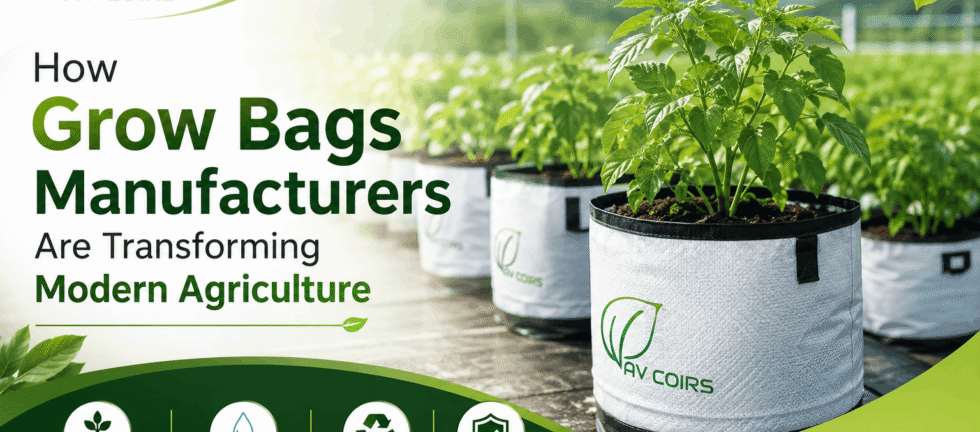
Ask any farmer who’s been at this for a while, and they’ll tell you land isn’t getting any easier to work with. Soil quality is inconsistent, space is shrinking, and cities keep creeping into what used to be farmland. That’s the backdrop against which a good grow bags manufacturer actually starts
Instead of gambling on unpredictable field soil, growers are switching to coco peat and coir-based grow bags that give them real control over water, root health, and how consistently a crop performs from one cycle to the next. AV Coirs has been sitting right in the middle of this shift for years now, working with coco coir products that actually hold up in a working greenhouse or hydroponic setup — not just on paper. So let’s get into why grow bags matter, what manufacturers are doing differently, and what’s actually worth checking before you pick one.
The Growing Importance of Grow Bags in Modern Agriculture
Farming just looks different than it did a decade ago. Land is tighter, cities keep expanding outward, and a lot of growers are stuck working with soil that’s either too depleted or too unpredictable to trust season after season. Naturally, that’s pushed people toward container-based growing instead of the old open-field approach.
Grow bags slot into that shift pretty naturally. You’ll see them doing real work in:
- Urban farming setups where there’s barely any space to spare
- Greenhouse and polyhouse cultivation
- Hydroponic systems that skip soil altogether
- Regions where the native soil is poor, contaminated, or just worn out
As more growers chase sustainable farming solutions without sacrificing yield, grow bags have quietly gone from “nice alternative” to something close to the default in commercial horticulture.
How Grow Bags Manufacturers Are Supporting Sustainable Farming
Here’s something people don’t think about enough — a grow bag is really only as good as the manufacturer standing behind it. Technically, anyone can stuff coco peat into a bag. Getting the water retention, aeration, and pH actually right? That takes real process discipline, not guesswork.
A genuine Coco peat grow bags manufacturer gets there through proper washing, buffering, and grading of the raw coir before it ever touches packaging. Skip that step, or rush it, and you end up with coir carrying excess salts that slowly stress plant roots over an entire growing season — often without anyone noticing until yields drop.
What solid manufacturing actually gets you:
- Coir that holds moisture without drowning the roots
- A fibrous structure that keeps roots properly aerated instead of suffocated
- Consistency across batches — not just a good-looking first sample
- A production process that’s genuinely eco-friendly, since coir starts life as coconut husk waste
This is also exactly where a dependable coir grow bags manufacturer earns their name — not through marketing copy, but through batch after batch performing the same way, order after order.
Benefits of Using Cocopeat Grow Bags for Commercial Farming
Once growers actually make the switch, the difference tends to show up fast. A few reasons cocopeat keeps winning people over:
- Better crop management — root zones stay predictable, so irrigation and feeding schedules are easier to plan around
- Less soil dependency — no more crossing your fingers over inconsistent field conditions
- Stronger plant growth — better aeration generally means healthier, more resilient root systems
- Easy to transport — bags stay compressed until hydrated, keeping shipping costs down considerably
- Works across crop types — vegetables, ornamentals, nursery stock, all of it
- Cost-effective long-term — especially once you factor in reusing bags across multiple cycles
For commercial operations working on thin margins, that mix of predictability and lower long-term cost isn’t something easy to ignore.
Applications of Grow Bags in Agriculture and Horticulture
Grow bags aren’t a one-trick product — they show up in more corners of agriculture than people usually expect:
- Hydroponic farming — functioning as a soil-free medium for nutrient delivery
- Greenhouse farming — tomatoes, cucumbers, peppers, and similar crops thrive in these setups
- Vegetable cultivation — both large commercial operations and smaller-scale farms
- Nursery plants — ideal for seedling propagation and transplant prep
- Commercial agriculture — especially export-focused, large-volume farming
- Home gardening — increasingly common among urban and terrace growers too
That spread of use cases is a big part of why demand for agriculture growing bags keeps climbing across pretty different markets and climates.
Why Choose AV Coirs as a Grow Bags Manufacturer?
AV Coirs doesn’t treat this as just another product line sitting on a shelf — it’s a full manufacturing process built around one thing: consistency, order after order.
A few things buyers tend to notice:
- Coco coir sourced and processed with quality treated as non-negotiable, not an afterthought
- Manufacturing capacity that scales comfortably from small orders up to large commercial volumes
- Batch-to-batch reliability, so a bulk order doesn’t turn into a mixed bag of hits and misses
- Genuinely export quality grow bags, backed by the documentation international shipments actually require
- Support for bulk orders that doesn’t drag on for weeks
- A production approach that leans into sustainability, since coir comes from coconut waste rather than something being mined or depleted
For farmers, distributors, and businesses hunting for a grow bags manufacturer they can lean on season after season, that combination of quality and capacity tends to be exactly what tips the decision.
How to Select the Right Grow Bags Manufacturer
Before signing off on a supplier, it’s worth running through a short mental checklist:
- Product quality — has the coir actually been washed, buffered, and tested, or just assumed to be fine?
- Manufacturing experience — how long have they genuinely been producing agriculture-grade coir products?
- Customization options — can bag size and packaging flex to your specific crop needs?
- Supply capacity — can they realistically handle your order volume without slipping deadlines?
- Delivery reliability — do they have a track record of getting bulk and export shipments out on time?
- Industry reputation — what are other farmers or distributors actually saying about them?
A grow bags manufacturer that’s confident in their own process won’t hesitate to hand over test results or samples before you commit to a large order. If they hesitate, that tells you something too.
Frequently Asked Questions
What does a grow bags manufacturer provide?
A grow bags manufacturer produces bags filled with a growing medium — usually cocopeat or coir — processed and tested for pH, moisture, and aeration so plants can grow well in soil-free setups.
Why are cocopeat grow bags popular in agriculture?
Cocopeat holds water efficiently, keeps roots properly aerated, and offers a renewable, organic growing medium, making it a solid alternative to soil that’s often too unpredictable to trust.
Are grow bags suitable for greenhouse farming?
Yes — grow bags are widely used in greenhouse and polyhouse farming for crops like tomatoes, cucumbers, and peppers, giving growers far more control over root-zone conditions than open soil allows.
How do I choose a reliable grow bags supplier?
Check their quality testing process, how long they’ve been manufacturing, whether they offer customization, their supply capacity, and their delivery track record before placing a bulk or export order.
Why are coir grow bags considered sustainable?
They’re made from coconut husk waste, a renewable byproduct, which makes them a noticeably more environmentally responsible choice than peat moss and other non-renewable growing mediums.
Conclusion
Grow bags have quietly turned into one of the more practical shifts happening in agriculture right now giving farmers a way to grow consistently without betting everything on unpredictable soil. But the manufacturer behind that bag matters just as much as the concept itself. Proper buffering, real testing, careful sourcing,that’s what separates a grow bag that performs from one that just looks fine in the packaging.
AV Coirs has built its entire process around that kind of reliability, supplying grow bags manufacturer solutions to farmers, distributors, and businesses across India and international markets alike. If you’re sourcing cocopeat or coir grow bags for your next growing cycle, it’s worth reaching out to AV Coirs directly for samples, bulk pricing, or export inquiries.