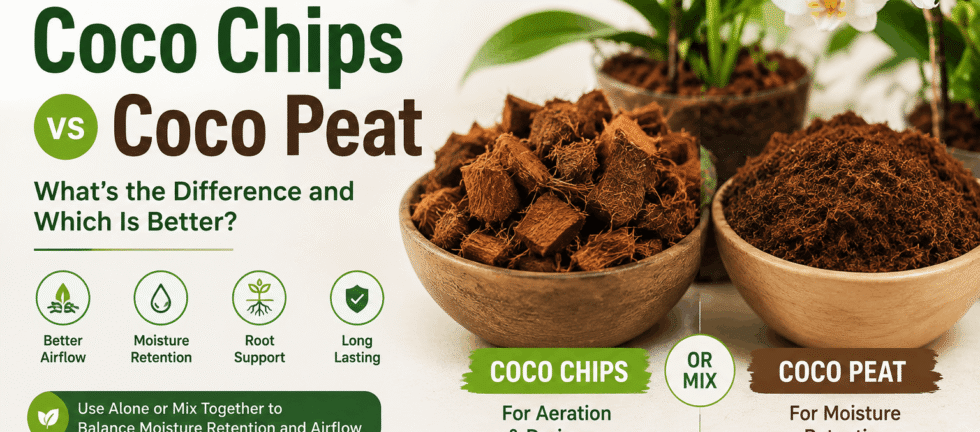
Choosing the growing medium can make a big difference in how plants receive moisture, airflow, drainage and root support. Coco chips are made from natural coconut husks. Processed into uniform pieces that give a mix of moisture retention and airflow. AV Coirs says that coco chips are used by orchid growers, anthurium cultivators, horticulture professionals, commercial growers and home gardeners. The company also says that coco chips can be used alone or mixed with coco peat to balance moisture retention and airflow.
How do coco chips compare with coco peat and which option is better? The answer depends on characteristics and application rather than on the assumption that one product fits every growing situation.
Coco Chips, vs Coco Peat: What Is the Difference? Coco chips come from natural coconut husks. Are cut into uniform pieces. According to AV Coirs the structure of coco chips helps improve aeration while retaining moisture efficiently and supporting root development.Their durable structure is also described as long-lasting compared with bark.
Coco peat is a coconut-based growing material offered by AV Coirs. However the official product information for coco chips does not include detailed specifications to allow a full technical comparison between coco chips and coco peat. Factors like particle structure, pH, EC, expansion ratio or other lab-based measurements are not clearly provided. Because of this any direct comparison between the two materials should not be assumed.
One key point made directly by AV Coirs is that coco chips can be used on their own or mixed with coco peat. The purpose of this mix is to balance moisture retention and airflow. This makes the relationship between coco chips and coco peat especially important, for growers who are considering combinations of growing media.
What Are Coco Chips?
Coco chips are pieces of natural coconut husk that have been processed into chips. Their physical structure is a feature because it helps create good airflow while still holding moisture.AV Coirs specifically describes the product as an excellent growing medium for plants.
The product is positioned for a variety of users. AV Coirs states that coco chips are widely used by orchid growers, anthurium cultivators, horticulture professionals, commercial growers, and home gardeners. This indicates that the product can serve both professional cultivation and home gardening applications.
Another stated characteristic is durability. According to AV Coirs, the structure of its coco chips provides long-lasting performance without quick degradation, unlike bark. This durability is presented as one of the reasons the product can be considered an alternative to traditional bark or soil mixes.
The product is also described as clean and uniform, with no wastage. These characteristics are relevant when growers are looking for a consistent growing medium.
What Is Coco Peat?
Coco peat is also part of the coir product range offered by AV Coirs. The company’s website identifies coir peat as one of its products alongside coco chips and other coir-based products. AV Coirs also describes its broader coir pith products as being extracted from coconut husk.
However the official Coco Chips product page does not give detailed information about coco peat to clearly show every technical difference between the two materials. For example it would not be right to include pH values, particle sizes, moisture percentages, expansion ratios or lab specifications, without official backing.
What the source does establish is particularly useful: AV Coirs states that coco chips can be used alone or mixed with coco peat to balance moisture retention and airflow. Therefore, the two products do not necessarily have to be treated as competing choices in every growing situation.
Coco Chips vs Coco Peat: Comparing Their Characteristics
The most reliable way to compare coco chips and coco peat is to stay within the characteristics specifically provided by AV Coirs.
Structure
I love Coco chips. Coco chips are made by chipping natural coconut husks into pieces and their structure helps with airflow and keeps moisture.AV Coirs also highlights their durability and long-lasting nature.
The official source does not provide enough equivalent technical information about coco peat to establish a detailed structural comparison.
Moisture Retention
Moisture management is one of the clearly stated characteristics of coco chips. AV Coirs says the product retains moisture efficiently and provides excellent water retention while allowing airflow.
AV Coirs also specifically states that coco chips can be mixed with coco peat to balance moisture retention and airflow. This is a useful source-supported point when considering how the two materials can work together.
Aeration
Aeration is another important stated characteristic of coco chips. Their structure allows airflow while retaining moisture, creating the type of growing environment described by AV Coirs for plant cultivation.
The official source does not provide sufficient technical data to quantify the aeration difference between coco chips and coco peat.
Drainage
AV Coirs states that its coco chips provide superior drainage. This is presented alongside water retention and airflow characteristics.
Because detailed equivalent drainage information for coco peat is not provided on the source used for this article, a numerical or technical comparison would not be appropriate.
Root Development
Supporting healthy root development is another stated benefit of coco chips. AV Coirs describes the product as helping create an appropriate root environment for stronger and healthier plants.
Coco Chips vs Coco Peat Comparison Table
| Factor | Coco Chips | Coco Peat |
| Source | Natural coconut husks | Coco-based product offered by AV Coirs |
| Form | Uniform chipped pieces | Not specified on the official source |
| Moisture characteristics | Efficient moisture retention | Detailed comparison not specified |
| Airflow | Allows airflow | Detailed comparison not specified |
| Drainage | Superior drainage stated by AV Coirs | Detailed comparison not specified |
| Root support | Supports healthy root development | Detailed comparison not specified |
| Applications | Orchids, anthuriums, horticulture, commercial growing and home gardening | Detailed applications not established from the source used |
This table intentionally avoids unsupported technical specifications.
Benefits of Coco Chips
The benefits of coco chips described by AV Coirs focus on their structure and growing performance. One major benefit is the mix of water retention and airflow. The product holds moisture while letting air move through helping make a home for roots. The product holds moisture while letting air move through helping make a home for roots.
Another stated benefit is superior drainage. This characteristic is important because the product is designed to retain water while also supporting airflow and drainage. AV Coirs also says that coco chips have a Cation Exchange Capacity or CEC.
Durability is another advantage the company points out. Coco chips last a long time and do not break down quickly like bark. Coco chips are also clean, even and waste‑free.
AV Coirs also says that coco chips can cut fertilizer usage by up to 30 percent and lower transplant shock while helping roots stay healthy. These claims come from the product page and should be seen as information from the maker not proof from independent tests.
Coco Chips vs Coco Peat: Which Is Better, for Different Uses?
You do not need to call one product overall if the official information does not back that up.Instead, the intended application and the stated product characteristics should guide the choice.
AV Coirs places coco chips for orchid growers, anthurium cultivators, horticulture professionals, commercial growers and home gardeners. The moisture retention of coco chips, the airflow of coco chips, the drainage of coco chips, the durability of coco chips and the root‑support of coco chips make these uses central to the product description.
AV Coirs also says that coco chips can be used alone or mixed with coco peat. This is especially relevant, for growers who wish to combine the characteristics of coco chips and coco peat in choosing one over the other.
For applications where a grower specifically needs the characteristics described for coco chips, the product provides a clearly stated option. For applications requiring a detailed technical comparison with coco peat, however, additional specifications would need to come from the supplier because they are not established on the official source used here.
Coco Chips for Hydroponics and Growing Applications
When considering coco chips for growing applications, it is important to rely on the applications actually stated by AV Coirs. The company sees coco chips as a type of growing material. Specifically talks about people who grow orchids, anthuriums, other plants, large-scale growers and people who have gardens at home.
The product’s ability to hold water, let air in drain and help roots grow is very important, for how it is used as a growing material.
The available official product information does not provide sufficient detailed technical information to make crop-specific hydroponic performance claims or guarantee particular yields. Therefore, such claims should not be added when evaluating the product.
Coco Chips for Horticulture and Plant Cultivation
Horticulture is one of the clearest application areas mentioned by AV Coirs. The company specifically identifies horticulture professionals among the users of coco chips and also mentions orchid and anthurium cultivation.
For these applications the product description keeps moisture in place while letting air flow through the product description drains water and the product description helps roots grow healthy.These characteristics are presented as part of the growing environment created by the product.
For home gardeners, the product is also positioned as a growing medium that can help create a suitable environment for plants. Its uniform structure and long-lasting performance add to the product characteristics highlighted by AV Coirs.
Quality Factors to Consider When Buying Coco Chips
When buying coco chips, product consistency and characteristics are important considerations. AV Coirs describes its coco chips as clean and uniform, with no wastage. The company also highlights their durable structure and stated long-lasting performance.
Buyers can therefore focus on the characteristics actually stated by the manufacturer, including uniformity, cleanliness, moisture retention, airflow, drainage, and the intended growing application.
The broader AV Coirs website also states that its products are manufactured in its factory and that this allows the company to control product quality and offer competitive prices. It also states that the company has the capacity to manufacture and supply custom coir products at higher volumes according to customer needs.
How to Choose Between Coco Chips and Coco Peat
The choice between coco chips and coco peat should begin with the intended growing application. If the characteristics described by AV Coirs match your requirements, coco chips offer a growing medium with moisture retention, airflow, drainage, durability, and root-support characteristics.
Another option is to consider using coco chips with coco peat. AV Coirs specifically states that coco chips can be used alone or mixed with coco peat to balance moisture retention and airflow.
For buyers who need detailed technical specifications for coco peat, the official source used for this comparison does not provide enough information to make a complete technical comparison. The best approach is therefore to evaluate the specific characteristics and intended application rather than assuming that one medium is always better.
About AV Coirs
AV Coirs is a coir products manufacturer located in Pollachi, Tamil Nadu, India.The official website says that the company makes coir pith from coconut husk.AV Coirs offers a range of coir products.These coir products include coir fibre, coir peat, coco chips, coco pith coins, coir mulch mats, ropes, grow bags, coir poles and other coir-based items.
The company states that its products are manufactured in its factory, giving it control over product quality. It also states that it can manufacture and supply custom coir products at higher volumes to meet customer requirements.
For buyers researching coco chips, this company information helps establish the source behind the product and provides useful context when evaluating a supplier.
Why Choose Coco Chips from AV Coirs?
AV Coirs points out that its coco chips have key features. These include uniformity, cleanliness, good moisture retention, proper airflow, effective drainage and durability. The coco chips also help support root development. The company says that horticulture professionals, orchid growers, anthurium cultivators, commercial growers and home gardeners all use the product.
The broader company website states that AV Coirs focuses on quality control through manufacturing in its own factory and can supply custom coir products at higher volumes.
These verified product and company details provide a factual basis for buyers considering coco chips for their growing applications.
Frequently Asked Questions About Coco Chips and Coco Peat
What are coco chips?
Coco chips come from natural coconut husks. Are cut into pieces that are all the same size. AV Coirs says they are a type of growing medium that helps hold water, allows air to move through drains well and helps roots grow strong.
What is coco peat?
Coco peat is a coir-based product offered by AV Coirs. The official website lists coir peat as part of its product range. However the source used for this article does not offer technical details to make a full comparison with coco chips.
So what is the difference between coco chips and coco peat?
The clear distinction supported by sources is that coco chips are uniform pieces made from natural coconut husks. AV Coirs also mentions that coco chips can be used by themselves or mixed with coco peat. This combination helps balance moisture retention and airflow.
Now what are the benefits of coco chips?
The benefits include moisture retention. They also allow for airflow. Drainage is improved. Roots grow healthier. The material is durable. It stays uniform in size.. It performs well over a long period. AV Coirs also states a reduction in fertilizer usage of up to 30%.
Are coco chips suitable for hydroponics?
The official product information available here does not provide enough detailed information to make specific hydroponic performance or crop-yield claims. Such claims should not be taken for granted based on the information that’s available.
Which is better, coco chips or coco peat?
Neither should be declared universally better based on the available official information. The choice should depend on the intended application and the characteristics required. AV Coirs also says coco chips can be used with coco peat, which I find helpful.
How do I choose between coco chips and coco peat?
Start with the intended application. Compare the verified characteristics from the supplier. For coco chips AV Coirs clearly states moisture retention, airflow, drainage, durability and root-support characteristics, which I find useful.
Final Thoughts
The comparison between coco chips and coco peat does not have to end with a winner. Based on the AV Coirs information coco chips offer a clearly defined combination of moisture retention, airflow, drainage, durability and root-development support, which I think is clear. They are used by orchid growers, anthurium cultivators, horticulture professionals, commercial growers and home gardeners.
AV Coirs also says coco chips can be used alone or mixed with coco peat to balance moisture retention and airflow which I think is valuable. This means the right choice can depend on the intended application and the characteristics required by the grower.
For readers comparing coco chips with coco peat the reliable approach is to focus on verified product information rather than unsupported technical assumptions. I always recommend focusing on verified product information.