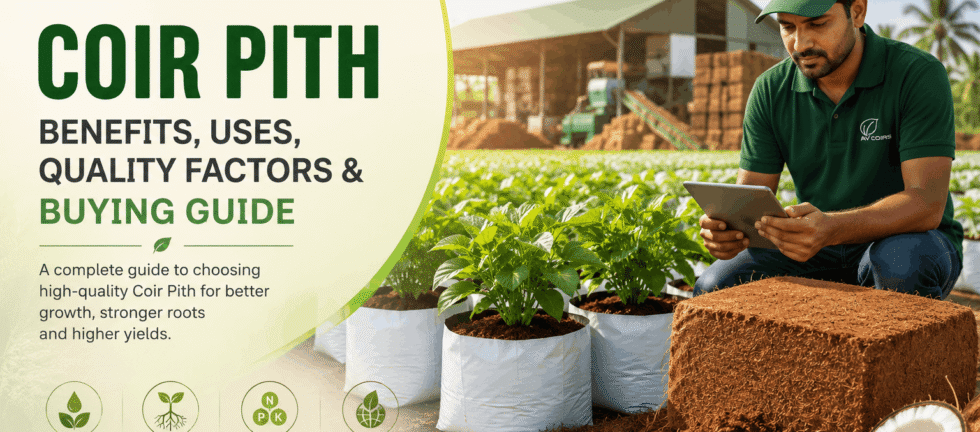
Coir pith has become a natural growing medium for agriculture, horticulture, nurseries, greenhouse cultivation, hydroponics, gardening and landscaping. It is also called coco peat. It comes from the husk after coir fibre is removed. The fine texture of Coir pith keeps moisture, lets air reach roots, holds nutrients and comes from a source.
That makes Coco peat a useful growing substrate for cultivation needs. AV Coirs makes coir pith that is washed, buffered, dried, screened and compressed. AV Coirs sells this product in blocks, bricks, bales, grow bags and custom packaging. This guide tells you what Coir pith is, its benefits and uses key quality factors, the available product types and what buyers need to think about when picking a supplier.
What Is Coir Pith?
Coir pith is a material that comes from processing coconut husk into coir fibre. When the long coir fibres are removed the finer material that remains is called Coir pith. According to AV Coirs this material is treated, washed, buffered, dried and compressed. The result is a growing medium called coco peat.
The fine texture of this pith keeps moisture while still letting air pockets form. Those air pockets support root health. AV Coirs says Coir pith is a friendly alternative to peat moss. AV Coirs also says coco peat is biodegradable and sustainable. Coco peat supports root growth, nutrient availability and balanced moisture in soil.
For growers the combination of moisture retention and root aeration makes Coir pith useful, for growing applications.Its processed form also allows it to be supplied in different formats according to cultivation and customer requirements.
Benefits of Coir Pith for Growing Applications
The properties of coir pith make it useful as a growing substrate. AV Coirs identifies several benefits that explain why this coconut-based material is used across different cultivation environments.
Excellent Water Retention
One of the benefits of coco peat is its ability to absorb and keep a lot of water. This helps give plants moisture and can cut down on how often you need to water them.
Keeping the right level of moisture is very important, in growing systems where it is necessary to have a steady place to grow.The water-holding characteristic of coir pith is therefore one of its key product properties.
Superior Root Aeration
Although coir pith retains moisture, AV Coirs states that it maintains its structure and allows air to move around plant roots. This provides oxygen availability around the root area and supports root formation.
The combination of water retention and air availability gives coir pith a useful role as a growing medium where both moisture and root aeration are important.
High Nutrient Holding Capacity
AV Coirs also points out the cation exchange capacity or CEC of coir pith. The product page says that this feature lets coir pith hold nutrients and then give them out slowly to plant roots, which helps fertilizer work well.
Because of this, managing nutrients becomes a factor when I use coco peat in growing plants.
Eco-Friendly Growing Medium
Coir pith comes from coconut husks and AV Coirs says it is renewable and biodegradable. I think coir pith is a choice for eco-friendly growing.
It is a natural byproduct of coir manufacturing rather than a non-renewable growing medium.Its coconut-based origin makes coir pith relevant to sustainable agriculture and growing applications where renewable growing materials are preferred.
Uses of Coir Pith
The applications of coir pith extend across several areas of agriculture and horticulture. AV Coirs specifically identifies greenhouse cultivation, hydroponics, nurseries, seed germination, commercial farming, potting mixes, and landscaping among its applications.
Greenhouse Cultivation
In greenhouse farming coir pith is used to keep the moisture level while making sure the roots get enough air. AV Coirs says that coconut peat can help grow vegetables, flowers, herbs and fruit in places where the environment is controlled.
Hydroponics
Coir pith is also used as a substrate in hydroponics. Its moisture retention, drainage, structure and CEC are identified as characteristics for hydroponic growing systems. Coir pith holds water well. Still let excess water drain away. It has a structure that supports plant roots. The cation exchange capacity of coir pith helps nutrients stay available to plants. This makes coir pith a strong choice, for hydroponic setups. Many growers prefer it because it works well with types of plants. It is also easy to handle and manage during the growing process.Washed and buffered coir pith is specifically described by AV Coirs as suitable for hydroponic systems.
Nurseries and Seed Germination
Nurseries use coconut peat as a growing medium, for seeds and seedlings. Coconut peat is described by AV Coirs as a light medium that holds moisture and helps with rooting during germination and early plant development.
Commercial Farming
Coir pith is used in agriculture for crops such as tomato, cucumber, strawberry and capsicum. Coir pith helps grow these crops. AV Coirs states that its properties support better rooting with less irrigation.
Potting Mixes and Landscaping
Another application is potting and landscaping. Coir pith can be combined with coco chips to create a growing mix for plants. This combination is also referenced by AV Coirs in its product information.
Coir pith as a growing medium
The importance of coir pith as a growing medium comes from a mix of qualities instead of just one single trait. The soft feel of coir pith helps it hold water and the way it is structured creates spaces for air, around the roots.AV Coirs also highlights its nutrient holding capacity and drainage characteristics.
For hydroponics greenhouse growing and nursery uses these traits can be very important because farmers need a material that can control water levels while making sure roots get air. The material needs to hold water. Also let air move around the roots. This is essential for plant growth. Growers look for something that balances both water and air.
This balance helps plants grow better and stay strong. Different types of plants might need balances. So the right material is key for success. The right choice makes a difference in how well the plants do. It’s important to pick the option for each situation. The goal is to keep the plants healthy and growing well. That’s why the right material matters a lot. Choosing the material is a big part of the process. It helps ensure the plants get what they need. This is why the right material is so important. The right material makes all the difference.
AV Coirs also states that coir pith can be used with coco chips to improve aeration or supplied in grow bags for vegetable cultivation. This provides different ways for growers to use coconut-based growing products according to their cultivation requirements.
Quality factors to consider when choosing coir pith
Choosing quality coir pith requires attention to how the material’s processed and the characteristics supplied by the manufacturer.AV Coirs describes several stages in its production process that contribute to product consistency.
The coconut husks used by AV Coirs come from areas where coconuts grow near Pollachi and Coimbatore. After taking out the coir fibre the pith is checked for any things and washed to get rid of extra salts.It is then buffered to produce low EC coco peat suitable for sensitive crops.
The material is subsequently dried to achieve the required hydration level and sieved to obtain the required texture. AV Coirs states that quality control testing is performed on every batch for moisture content, pH, and consistency before domestic delivery and export.
For buyers, these processing and quality control steps provide useful points to consider when comparing coir pith suppliers.
How to Choose the Right Coir Pith
Selecting the right coir pith starts with understanding the intended cultivation application. A product intended for commercial farming may have different packaging requirements from one intended for home gardening or nursery use.
AV Coirs recommends considering factors including washed and buffered material, low EC and pH-balanced products, consistent grading, high water holding capacity, reliable manufacturing processes, export-quality packaging, bulk supply capability, timely delivery, and technical support. The company also highlights customized packaging options and quality control throughout production.
The form of coir pith is another consideration. AV Coirs offers blocks, bricks, bales, grow bags, open-top grow bags, coir discs, and customized packaging. Selecting the appropriate format can therefore depend on the intended use, quantity, and customer requirements.
Coir Pith for Horticulture and Plant Cultivation
Coir pith is widely positioned by AV Coirs for horticultural and plant cultivation applications. It is used in nurseries, greenhouse farming, hydroponics, commercial agriculture, potting and landscaping. This shows the different growing environments where the product can be used.
For nurseries the product helps with moisture retention which supports seed and seedling rooting. In greenhouse environments it helps keep moisture levels steady while allowing air to reach the roots. In hydroponic cultivation. Buffered coir pith offers moisture retention, good drainage and the ability to hold nutrients.
The product is also available in grow bags and top grow bags. These include formats that are meant for vegetables and for hydroponic farming.
Coir Pith for Sustainable Growing Applications
Sustainability is a trait that comes with coir pith. AV Coirs tells us that this material comes from coconut husks and calls it renewable, biodegradable and sustainable. Coir pith is made as a byproduct while coir fibre is produced.
This gives coir pith a role in growing systems that use coconut-based materials. AV Coirs also describes it as an environmentally friendly alternative to peat moss.
The sustainability characteristics stated by the manufacturer are connected to its coconut husk origin and biodegradable nature. No additional environmental performance claims should be assumed beyond the information provided by AV Coirs.
Types of Coir Pith Products
AV Coirs manufactures several forms of coir pith for different cultivation and supply requirements.
- 5 kg Coir Pith Blocks: Intended for commercial farming and export.
- 650 g Coir Pith Bricks: Suitable for retail and home gardening.
- Coir Pith Bales: Bulk packaging for agricultural applications.
- Grow Bags: Ready-to-use growing solutions for greenhouse cultivation.
- Open Top Grow Bags: Used for vegetables and hydroponic farming.
- Coir Discs: Designed for nurseries and potted plants.
- Customized Packaging: Available according to customer specifications and export requirements.
These formats allow coir pith to be supplied for different cultivation scales and requirements.
About AV Coirs
AV Coirs is located in Pollachi, Coimbatore. I have heard that AV Coirs calls itself a coir pith manufacturer that serves customers in India and abroad. AV Coirs says it has years of experience making coir pith. AV Coirs turns husks into coco peat using a controlled process.
AV Coirs explains that its production steps include washing, buffering, drying, screening and quality checks. AV Coirs offers forms of coir pith: 5 kg blocks, bricks grow bags and custom products for export.
AV Coirs also sells horticulture items such as grow bags, coco chips, coir fibre, coir discs and, open‑top grow bags. AV Coirs serves greenhouse operators, hydroponic growers, importers, distributors and nurseries.
Why Choose Coir Pith from AV Coirs?
AV Coirs offers coir pith in forms and explains how quality is checked at each step of making the product. The company says its material is washed, treated, dried, filtered and tested for moisture, pH and how it feels.
Different ways to get the product mean customers can choose coir pith that fits their way of growing and how they want to pack it. Blocks, bricks, bundles, grow bags, top grow bags, coir discs and special packing are shown on the official product page.
For people looking for a supplier the company’s emphasis on checking quality making sure the product is the same each time different packing choices, big amounts available and help with questions gives details to think about.
Frequently Asked Questions About Coir Pith
What is coir pith?
Coir pith is a growing material made from the inside of a coconut husk after the fibers are taken out. It goes through cleaning, treatment, drying and pressing to make coco peat.
What are the benefits of coir pith?
The main advantages mentioned by AV Coirs are that it holds water lets air reach the roots keeps nutrients drains well and is something that can be used again and breaks down naturally.
Where is coir pith used?
Coir pith is used in greenhouses in water-based growing systems in places that start plants for growing seeds in farming in mixtures for pots and in outside areas where plants are grown.
Is coir pith the same as coco peat?
Yes. AV Coirs says that coir pith and coco peat are two names for the same material that comes from the coconut husk and is used as a place where plants grow.
Can coir pith be used again?
Yes. AV Coirs says that coir pith can be used for growing times if it is cleaned and treated right depending on what is being grown and how it is done.
Is coir pith good for hydroponics?
Yes. AV Coirs says that coir pith that has been cleaned and treated is good for water-based growing systems because it helps the roots grow while keeping the balance of water and nutrients.
What is EC, in coco peat?
EC, or electrical conductivity, indicates the salt content in coco peat. AV Coirs states that low EC products are generally preferred for sensitive crops.
Final Thoughts
Coir pith provides a mix of moisture retention, root aeration, ability to hold nutrients, drainage and comes from a renewable source. This makes it good for types of growing needs. It can be used in greenhouses, hydroponics, nurseries, commercial farming, potting mixes and landscaping.
The uses of coir pith cover a range of growing needs. AV Coirs offers coir pith in blocks, bricks, bales, grow bags, coir discs and other custom forms. The company follows processing steps, like washing, buffering, drying, screening and checking quality. For people who want to buy coir pith knowing the purpose they need it for the shape it comes in, how it is processed, how consistent it is and its quality can help them choose the coir pith for their growing needs.