
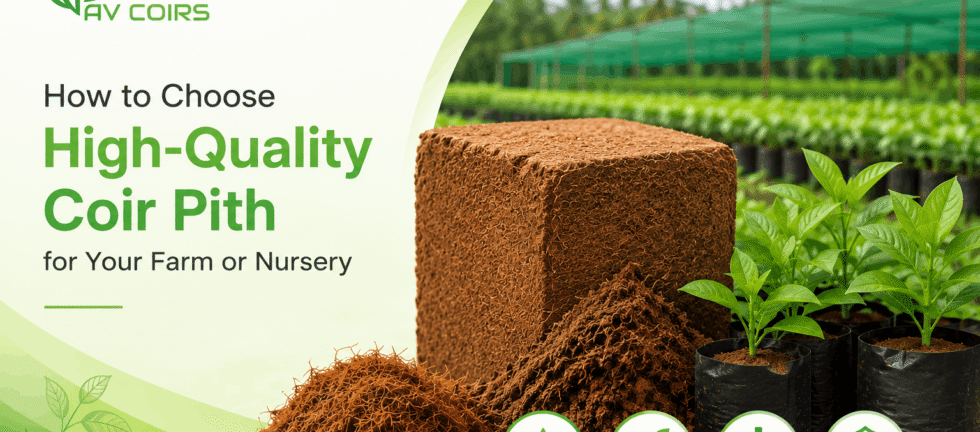
In case you’ve opened a coir pith block expecting to find it soft, dark, and pleasant but came across a salty and dusty product that ruined your seedlings already you know that this decision is important. Indeed, similar products look the same across different suppliers. The packaging, the blocks, and the color may be similar from one provider to another. However, there is always a big difference in the way these items function. If farms face problems with the quality of the coir pith, the process will cause delays in germination and failures due to excessive salt.
So that is why it is very important to know all the details about the product before ordering it in large quantities.
What Makes Coir Pith(Coco peat) High Quality?
High-quality coir pith has a low EC value (less than 0.5 mS/cm) after washing, a pH of about 5.5 to 6.8, moisture content between 12-18%, little dust-to-fiber ratio, and consistent block density with the good expansion ratio. The excess salts of sodium and chloride should also be absent from coir pith.
What Exactly Is Coir Pith?
Coir pith(Coco peat) is a material derived from coconut husks. It is located between the outer and inner layers of the husk and is a growing medium in many horticultural and agricultural applications. Coir pith is a good water holder, allows good aeration, and promotes root development — but only when processed and matured properly.
Unfortunately, this is where issues with quality emerge. Fresh coir pith has an unusually high concentration of salt and tannins that will remain in the pith if the material is not properly washed and buffered.
Key Quality Parameters to Check Before Buying Coir Pith
This is the part most buyers skip, and it’s exactly where the real difference between suppliers shows up. Don’t just ask “is this a good coir pith?” Ask for numbers.
1. Electrical Conductivity (EC)
EC indicates how much soluble salt is present in the coir pith. Unprocessed coir product may have the EC of above 2.0 mS/cm, which is too high for most plants. Quality material must have the EC of less than 0.5 mS/cm after the water extract test. In case a supplier is unable to provide you with the EC value, consider that a red flag rather than just oversight.
2. pH Range
Coir pith has an intrinsic acidic to neutral pH, with optimum levels being 5.5 to 6.8. Any deviation from this range can interfere with nutrient absorption; plants may exhibit signs of nutrient deficiency even if they are fed properly — the pH of the substrate prevents plants from assimilating nutrients.
3. Moisture Content
The moisture content of coir pith should usually be maintained between 12% and 18%. If it is too dry, it becomes powdery and difficult to hydrate; if it is too wet, one must pay for the weight of the water as well as risk mould formation in transit and storage.
4. Sodium and Chloride (Salt) Content
This is different from EC and needs individual testing if the coir pith comes from the area close to the sea. High sodium content has negative effects on plants.
5. Dust-to-Fibre Ratio
A good coir pith blend has a balanced mix of fine particles and short fibres. Too much dust reduces aeration and can lead to compaction and waterlogging around the root zone. Too much fibre, and water retention suffers. Ask your supplier about their particle grading process — reputable ones sieve and blend deliberately rather than selling whatever comes off the line.
6. Block Density and Expansion Ratio
If you’re buying compressed coir pith blocks, density matters more than most buyers realise. A well-compressed 5 kg block should expand to a predictable, consistent volume — usually somewhere between 60 and 75 litres when properly hydrated, depending on the compression standard used. Inconsistent expansion between blocks from the same batch usually points to uneven processing.
Quick Checklist: What to Ask Your Coir Pith Supplier
- EC value after washing (should be below 0.5 mS/cm)
- pH range (ideally 5.5–6.8)
- Moisture content percentage (12–18%)
- Sodium/chloride levels, especially for coastal-sourced material
- Dust-to-fibre ratio and particle grading process
- Block density and expected expansion ratio
- Whether the coir pith is buffered or unbuffered
- Batch consistency across multiple deliveries
Buffered vs. Unbuffered Coir Pith: Why It Matters
This appears to be one of those pieces of information that seems complicated but has a very significant effect on your crop. It is known that raw coir pith contains natural sodium and potassium ions at cation exchange places of the substance. Subsequently, when you introduce calcium and magnesium during nutrient preparation, the ions are going to prevent calcium and magnesium from reaching your plants at the initial stage of growth, when they require them the most.
In order to avoid that, buffering makes it possible; i.e., coir pith is treated by a calcium nitrate or calcium chloride solution. Buffered coir pith costs more than the non-buffered one. Buffered coir pith must pay off for growers as they have to deal with problems caused by lack of nutrients from coir pith; it is still possible to use unbuffered coir pith only if plans are adjusted.
How to Verify Quality Before You Commit to a Bulk Order
Don’t rely on supplier claims alone. A few practical steps go a long way:
- Request a sample batch and run a simple EC/pH test yourself using a handheld meter — it takes minutes and tells you more than any brochure will.
- Soak a small block and observe expansion time and volume. Slow, uneven expansion often signals inconsistent compression.
- Check for visible white salt crust on dried blocks — a common sign of poor washing.
- Ask about the source region — coir pith from areas with heavy monsoon washing tends to have naturally lower salt content than material from drier coastal zones.
- Request batch-to-batch consistency data if you’re placing recurring orders — this matters more for large nurseries than a single good sample ever will.
Common Mistakes Buyers Make
Even experienced buyers fall into a few predictable traps:
- Judging quality by colour alone. A dark, rich colour looks appealing but says nothing about EC or salt content.
- Skipping the EC test because “it looks clean.” Salts are invisible until they show up as leaf damage weeks later.
- Buying purely on price per kilo without factoring in expansion ratio — a cheaper, poorly compressed block can actually cost more per usable litre.
- Assuming all suppliers process coir pith the same way. Washing cycles, ageing time, and buffering practices vary significantly, even within the same region.
- Not asking about storage conditions. Coir pith stored in humid, poorly ventilated warehouses is prone to mould and uneven moisture distribution.
Coir Pith vs. Coco Chips: Which One Fits Your Setup?
Although coir pith is recognized for its ability to hold water and its amazing texture, some growers prefer to mix it with coco chips to achieve improved aeration and drainage especially for crops prone to waterlogging like some orchids or potted ornamentals. Coco chips are coarser coconut husk parts that create air pockets in the growing substance which fine coir pith does not provide entirely.
For most nursery and farm applications, straight coir pith works well as a base medium. But if your crop needs faster drainage or you’re growing in containers with limited depth, a coir pith and coco chips blend (often in a 70:30 or 60:40 ratio) can give you the best of both — moisture retention from the pith and airflow from the chips.
Final Thoughts
When it comes to selecting the right coir pith, the choice is not always determined by its price or by simply trusting a supplier. There are certain parameters, namely electrical conductivity, pH, moisture content, salt percentage, and consistency that influence the success of crop growth. Ask for numerical data, try out a sample, and do not hesitate to change a supplier if it turns out to be unstable.
In case you want to buy coir pith for your planting project, ask for the test data and do not forget to ask for a trial batch.
Frequently Asked Questions
- What EC level is considered safe for coco peat? An EC value below 0.5 mS/cm after a standard water-extract test is generally considered safe for most crops. Higher readings indicate excess salt content that can stress young roots.
- Is buffered coir pith always better than unbuffered? Not always — buffered coir pith reduces the risk of early calcium and magnesium deficiency, but unbuffered material can work fine if you’re able to adjust your nutrient feeding schedule accordingly.
- How long does coco peat take to expand after hydration? Most compressed blocks expand fully within 15 to 30 minutes when soaked in water, though this varies based on compression density and block size.
- Can I mix coir pith with coco chips for better results? Yes, blending coir pith with coco chips improves drainage and aeration, which is especially useful for crops that are sensitive to waterlogged roots.
- How can I test coir pith quality without lab equipment? A basic handheld EC and pH meter, along with a simple water-soak test to observe expansion and check for visible salt residue, can give you a reliable first impression before committing to a bulk purchase.